
What Is Accelerated Reading (AR), & How Does It Work?
Helping kids find the right books, build confidence, and discover a lifelong love of reading.
If you have a child in elementary or middle school, you've probably heard of Accelerated Reader, often called AR. But what exactly is it, and how does it work?
Accelerated Reader is a reading program developed by Renaissance Learning that many schools use to encourage independent reading, monitor reading comprehension, and help students develop stronger reading skills.
The idea is simple: children read books, take short quizzes to demonstrate their comprhension, and earn points based on the books they've read and how well they perform on the quizzes.
How Does Accelerated Reader Work?
Step 1: Find a Book
Students choose a book that interests them, often within a recommended reading-level range provided either by grade level, their teacher, or the Renaissance Learning website.
Books have an AR reading level, point value, and quiz number, which can help families find books that fit their child's reading abilities and school requirements.
Step 2: Read the Book
Children read the books
Step 3: Take an AR Quiz
After finishing the book, students take a short computerized reading comprehension quiz, usually through their school's Accelerated Reader program.
The quizzes are designed to measure how well the student understood and remembered what they read.
Step 4: Earn AR Points
Students earn points based on the book's point value and their quiz performance.
Schools may establish individual reading goals based on a student's reading ability, grade, and progress.
Step 5: Keep Reading!
As students complete books and quizzes, teachers can monitor their reading progress and help guide them toward books that offer an appropriate level of challenge.
And hopefully, along the way, children discover authors, characters, and genres that make them excited to pick up their next book.
Understanding AR Reading Levels
One of the most confusing parts of Accelerated Reader is understanding the numbers associated with each book.
An AR book level is generally based on a readability formula called ATOS, which considers factors such as vocabulary and sentence complexity.
For example:
AR 2.5: Text difficulty roughly equivalent to the fifth month of second grade.
AR 3.8: Text difficulty roughly equivalent to the eighth month of third grade.
AR 4.2: Text difficulty roughly equivalent to the second month of fourth grade.
AR 5.6: Text difficulty roughly equivalent to the sixth month of fifth grade.
It's important to remember that these numbers describe the difficulty of the text, not necessarily the age or grade for which the story is appropriate.
Reading ability and age-appropriate content are not always the same thing.
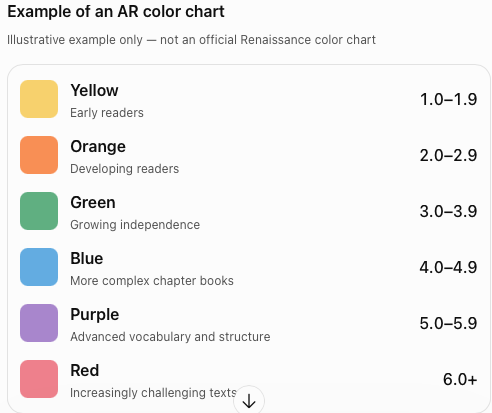
Many Schools Have Created an AR Color Coded System
Books are grouped into colors based on their Accelerated Reader (AR) reading levels. For example, a school might use yellow stickers for beginning readers, green for developing readers, and blue for more advanced readers. generally numbers correlate to grade level based on average readers.
However, there is no single universal AR color-coding system. Each school or library may choose its own colors and reading-level ranges. A green sticker at one school might represent a completely different reading level at another.
What Are AR Points?
Each AR book is assigned a point value based primarily on its length and reading difficulty.
Generally, longer and more challenging books are worth more points.
For example, a short early-reader book might be worth 0.5 points, while a longer chapter book might be worth 5, 10, or even 20 points.
Students earn points according to their performance on the quiz, subject to the program's scoring rules.
A book worth 10 points does not automatically earn a student 10 points just because they finish reading it.
And perhaps most importantly, more points don't necessarily mean a better book.
A wonderful story worth 2 points can be just as meaningful as a novel worth 15.
What Is an AR Quiz Number?
Every book with an Accelerated Reader quiz has a unique quiz number.
This number helps students and teachers locate the correct quiz within the AR program.
Quiz numbers are especially helpful when books have similar titles or multiple editions.
On A Life Full of Books, I include AR quiz numbers whenever they're available so families can identify the correct book more easily.
How Can Parents Find AR Books?
One of the easiest ways to look up a book's Accelerated Reader information is through AR BookFinder or This website!
You can search by title, author, or quiz number to find information such as:
AR reading level
AR point value
Quiz number
You can use the book reviews here on A Life Full of Books to discover new titles and find AR information in one convenient place.
Keep in mind that having an AR quiz does not necessarily mean every school has made that quiz available to its students.
Reading Is About So Much More Than Points
As a parent, I appreciate having tools that help measure reading progress and encourage children to challenge themselves.
But I also believe that reading should never become just another assignment or a race to earn the most points.
Some of the most valuable things children gain from books can't be measured by a quiz.
Reading develops imagination, empathy, curiosity, creativity, and an understanding of the world beyond our own experiences.
A child might finish a mystery and become interested in codebreaking. A historical novel might inspire a visit to a museum. A story set in another country might spark curiosity about geography, languages, or different cultures.
Those experiences are just as important as comprehension scores.
My hope is that children don't simply learn how to read well, but discover how much they love reading.
That's the heart behind A Life Full of Books.
Because the goal isn't just to finish more books.
It's to discover more of the world, one story at a time.
One life. A thousand stories. Endless adventures.